What are standard evaluation procedures?
Before your child’s health care provider can recommend treatment or rehabilitation, they must first find out the reason for, and source of, your child's condition. This typically means doing a full physical exam and taking a detailed health history. Tell your child's provider about any other illnesses, injuries, or complaints that have been linked to the pain or condition. Also tell the provider about any past treatments or medicines prescribed. Some early tests may then be done, including:
-
Blood tests
-
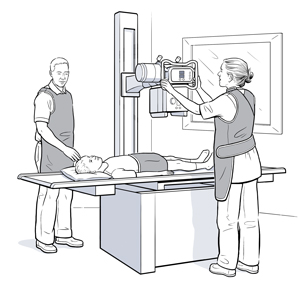
X-rays. A diagnostic test that uses electromagnetic energy to make images of internal tissues, bones, and organs onto film.
Advanced evaluation procedures
Children who need further evaluation may have one or more of the following:
-
MRI. This is a diagnostic procedure. It uses a combination of large magnets, radiofrequencies, and a computer to make detailed images of organs and structures in the body.
-
CT scan. This is a diagnostic imaging test. It uses a combination of X-rays and computer technology to make horizontal (axial) images of the body. A CT scan shows detailed images of any part of the body. This includes the bones, muscles, fat, and organs. CT scans are more detailed than general X-rays.
-
EMG (electromyogram). This test assesses nerve and muscle function.
-
Bone scan. This is a nuclear imaging test. It evaluates any degenerative or arthritic changes in the joints. It can also find bone diseases and tumors. And it can help find the cause of bone inflammation.
-
Ultrasound. This is becoming a common test for evaluating musculoskeletal complaints. It uses sound waves to form images of the body.
After reviewing the test results, your child's orthopedist will discuss all treatment choices with you. The health care provider will help you select the best treatment plan to help your child live an active and functional life.
Featured in

Bone and Joint Care
Find expert care for joint pain, injuries, and conditions that affect how you move at the HPH Bone & Joint Centers.
Learn MoreRelated Articles
Night Terrors
Watching your child have a night terror can be very upsetting. These tips can help you know what to expect and when your child might need to see a health care provider.
Disciplining Your Child at Any Age
Each child is different, but most children need to be given clear rules about behavior. Read on for some discipline tips by age group.
Hepatitis B Virus (HBV) in Children
An infant or young child who contracts hepatitis B is at greater risk of staying infected with the virus and of having lifelong liver problems, such as scarring of the liver and liver cancer.
Your Child’s Discharge from the Hospital
Planning for your child’s discharge from the hospital involves all members of your child’s care team. Here are some of the things to know about hospital discharge.