Your child needs a ventriculoperitoneal (VP) shunt revision. This type of brain surgery helps fix a problem with a VP shunt.
A VP shunt is used to treat hydrocephalus. This condition causes cerebrospinal fluid (CSF) to build up in the brain. The shunt uses a tube (catheter) to carry CSF out of the brain to the lining of the abdomen (peritoneum). This tube runs just under the skin. A small valve connected to the tube helps control the flow of CSF from the brain.
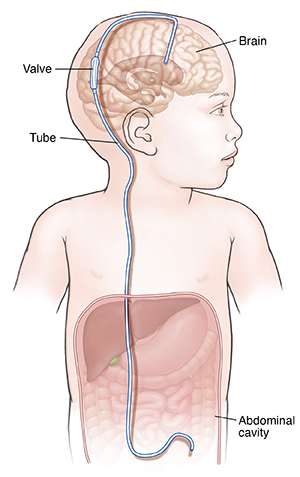
How to say it
vehn-TRIHK-yoo-loh-per-EH-tuh-NEEL
Why is a VP shut revision done?
This type of surgery is done when a VP shunt stops working. When that happens, CSF may start to build up again in your child’s brain. Your child may then have symptoms such as headaches, vomiting, vision problems, and behavior changes.
A VP shunt may stop working for many reasons. It may become blocked, disconnected, or broken. It can also move out of place as your child grows.
Your child may also need this surgery if part of the VP shunt, such as the valve or tube, becomes infected.
What happens before a VP shunt revision?
Before a VP shunt revision is done, your child will need some tests. Imaging tests, such as ultrasound or a CT scan, can help determine what is wrong with the VP shunt. In many cases, only one part of the shunt, such as the valve or tube, needs to be fixed or replaced. If your child has an infection, often the whole VP shunt is replaced.
How is a VP shunt revision done?
A VP shunt revision is done in a hospital. During it:
-
Your child lies face up on the operating table. A headrest may be placed underneath your child to better align their body and head for the surgery.
-
Your child is given medicine to make them fall asleep. They won’t feel any pain. They may also be given antibiotics to prevent an infection.
-
The surgeon makes a cut in your child’s head or body. The location depends on where the problem is in the shunt.
-
The surgeon fixes or replaces the part of the VP shunt that isn’t working. Or in case of an infection, the whole VP shunt may be replaced.
-
The surgeon tests the tube and the valve to make sure it's working right.
-
The surgeon closes up the cut or cuts in your child’s body.
What happens after a VP shunt revision?
After the surgery, your child will be taken to a recovery room. Health care providers will closely watch your child’s blood pressure, heart rate, and temperature. They will also check your child’s brain function. Your child will be asked some questions and told to move different parts of their body, like their limbs, fingers, and toes.
Your child will be able to go home within 1 to 2 days. Make sure your child follows all at-home care instructions. It will take a few weeks for your child to recover.
Risks of the procedure
A VP shunt revision has many of the same risks as the first surgery to put in the old VP shunt. These include:
-
Infection.
-
Bleeding.
-
Too much or too little drainage of CSF.
-
A blockage in the tube.
-
Shunt malfunction.
-
Seizures.
When to contact your child's doctor
Contact your child’s doctor right away if your child has:
-
An unexplained fever, especially with a stiff neck or confusion.
-
New seizures or change in seizure pattern.
-
An unusual headache.
-
Extreme drowsiness.
-
Vision changes.
-
Redness, swelling, bleeding, or discharge from the area where the shunt valve is.