Some treatments for periodontal disease don't include surgery. The goal of these treatments is to make conditions that allow tissues in the mouth to heal. This is done by reducing the infection caused by the bacteria in plaque and tartar, as well as other causes of periodontal disease. About
Scaling and root planing
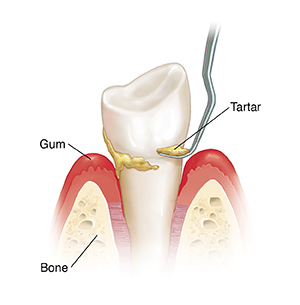
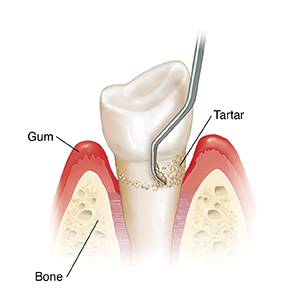
This treatment is done by a dentist or a dental hygienist. Sometimes a special ultrasonic device is used to remove heavy deposits. Then plaque and tartar are removed from above and below the gumline (scaling), and the root surfaces are smoothed (root planing). This helps to greatly reduce the harmful bacteria under the gums. It may also help ligaments that have broken down to reattach to the teeth. This reduces the depth of pockets that have formed in the gums around the teeth.
Antimicrobials
Infection can be treated with antimicrobials. They decrease bacteria. They may be in the form of antibiotics or other antibacterial agents, like chlorhexidine gluconate. Antibiotics may be taken in pill form or as a powder placed directly into the infected pocket. Chlorhexidine gluconate may be used as an oral rinse after brushing.
Bite correction
Bite problems, like an uneven bite, can make bone loss worse. Grinding or clenching the teeth may add to the problem. A splint or other ways of adjusting the bite can reduce pressure and help control the damage.
Home care
Home care is your best tool against periodontal disease. Brushing twice a day and flossing at least once a day can help improve your gum health. This can prevent tooth loss. It may also help you not need surgery. It’s easy to make a habit of brushing and flossing—and it’s not too late to start! Ask your dentist to show you the right way to brush and floss.
Online Medical Reviewer: Jessica Gotwals RN BSN MPH
Online Medical Reviewer: Michael Kapner MD
Online Medical Reviewer: Rita Sather RN
Date Last Reviewed: 02/01/2025
© 2000-2026 The StayWell Company, LLC. All rights reserved. This information is not intended as a substitute for professional medical care. Always follow your healthcare professional's instructions.