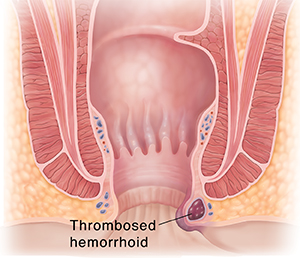
Hemorrhoids are swollen veins in the lower rectum and anus. They're a lot like varicose veins that form in the legs. Hemorrhoids can happen inside the rectum (internal hemorrhoids) or one may form at the anal opening (external hemorrhoids). In most cases, hemorrhoids aren't something to worry about, even if they bleed. But a thrombosed hemorrhoid is more painful. It occurs when a small blood clot (thrombus) develops in an external hemorrhoid. This can cause severe pain and sometimes bleeding.
When to go to the emergency room (ER)
If you have severe pain or excessive bleeding, get medical care right away.
What to expect in the ER
A healthcare provider is likely to check your anus and rectum using a thin, lighted tube (anoscope or proctoscope). You'll get a local pain reliever (anesthetic) to ease any mild pain.
Treatment
Treatment recommendations include:
-
If the blood clot has formed within the past 48 to 72 hours, your healthcare provider may remove it from within the hemorrhoid. This is a simple procedure that can ease pain. You'll have a local anesthetic to keep you pain-free during the procedure. The provider makes a small cut (incision) in the skin and removes the blood clot. Stitches are generally not needed.
-
If more than 72 hours have passed, your healthcare provider will suggest home treatments. Simple home treatments can ease your pain. These may include warm baths, ointments, suppositories, and witch hazel compresses. Many thrombosed hemorrhoids go away on their own in a few weeks.
-
If you have bleeding that continues or painful hemorrhoids, talk with your healthcare provider. Possible treatment may include banding, ligation, or surgical removal (hemorrhoidectomy).
Tips for preventing hemorrhoids
Tips include:
-
Eat high-fiber foods and use fiber supplements to help prevent constipation.
-
Drink plenty of liquids.
-
Get regular exercise to help prevent constipation and promote good bowel function.
Online Medical Reviewer: Jen Lehrer MD
Online Medical Reviewer: Raymond Kent Turley BSN MSN RN
Online Medical Reviewer: Rita Sather RN
Date Last Reviewed: 04/01/2024
© 2000-2026 The StayWell Company, LLC. All rights reserved. This information is not intended as a substitute for professional medical care. Always follow your healthcare professional's instructions.