YAG capsulotomy is a laser eye treatment. It is done to improve your vision after cataract surgery. Your vision can become cloudy again after cataract surgery. This is sometimes called an after cataract or a secondary cataract. But it isn't a new cataract. Instead, your posterior capsule, which holds the lens in place, becomes cloudy. Your eye care provider may do a YAG capsulotomy to help you see better.
Your eye after cataract surgery
When your cataract is removed, your eye's cloudy lens is replaced with a new clear plastic lens called an IOL (intraocular lens). The IOL is placed in the posterior capsule, which held the old cloudy lens. Your vision improves because the IOL lets light reach your retina. The retina is a tissue layer that lines the back of your eye.
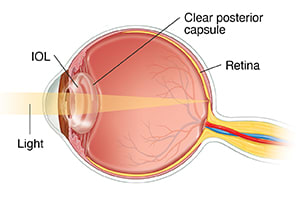
If the capsule becomes cloudy
The posterior capsule is a thin, clear film. It can become cloudy. This can happen months or even years after cataract surgery. This may block light from reaching your retina.
Online Medical Reviewer: Chris Haupert MD
Online Medical Reviewer: Raymond Kent Turley BSN MSN RN
Online Medical Reviewer: Rita Sather RN
Date Last Reviewed: 09/01/2025
© 2000-2026 The StayWell Company, LLC. All rights reserved. This information is not intended as a substitute for professional medical care. Always follow your healthcare professional's instructions.