There are methods you can use to help remove mucus from your airways. Clearing your airways helps you breathe better. It also lowers the chance for infection. You can try controlled coughing. You can also try the "huff" technique. Use any medicines before or after clearing your airways, as instructed by your health care provider. For example, some people use inhaled bronchodilators before clearing their airways.
Tip
Keep a box of tissues next to you when using these methods. Wash your hands when you are done.
Controlled coughing
Here's how to do it:
-
Sit on a chair with both feet on the floor.
-
Take a slow, deep breath through your nose. Hold for 2 counts.
-
Lean forward slightly.
-
Cough twice—2 short coughs.
-
Relax for a few seconds.
Repeat the steps as needed.
The “huff” technique
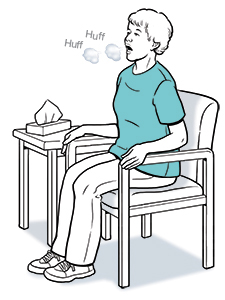
Here's how to do it:
-
Sit on a chair with both feet on the floor.
-
Take a slow, deep breath through your nose. Hold for 2 counts.
-
To breathe out, open your mouth. Then make a “huff” sound in your throat. (The same way you might breathe to clean a pair of eyeglasses.)
-
Huff 2 to 3 times as you breathe out.
-
Relax for a few seconds.
Repeat the steps as needed.
Follow-up care
Follow up with your health care provider as advised.
When to contact your doctor
Contact your health care provider right away if you have:
-
Shortness of breath, wheezing, or coughing.
-
Increased mucus.
-
Yellow, green, bloody, or smelly mucus.
-
Fever of 100.4°F (38°C) or higher, or as directed by your provider.
-
Chills.
-
Tightness in your chest that does not go away with rest or medicine.
-
An irregular heartbeat.
Online Medical Reviewer: Chris Southard RN
Online Medical Reviewer: Daphne Pierce-Smith RN MSN
Online Medical Reviewer: Rajadurai Samnishanth Researcher
Date Last Reviewed: 03/01/2025
© 2000-2026 The StayWell Company, LLC. All rights reserved. This information is not intended as a substitute for professional medical care. Always follow your healthcare professional's instructions.