If you have a tracheostomy tube
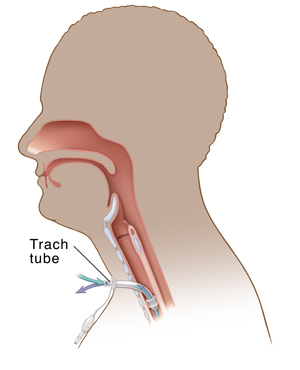
Your tracheostomy (trach) tube has been chosen to fit well and work right for you. You’ll learn how to keep it clean and clear. Often, a trach tube is needed for only a short time. Your surgeon will tell you how long to use the tube. If you don’t need a new airway after surgery, the hole in the front of your throat will close on its own after the trach tube has been removed. You will have a dressing over the site while it heals. In some cases, surgery is needed to close the hole.
If you have a stoma
Your larynx may have been removed during surgery. If so, you’ll continue to breathe through the hole in your throat. This hole is called a stoma. It's also called a permanent tracheostomy. Tell those who care for you that this is your only airway. In a medical emergency, a breathing tube can't be put in through your nose or mouth. You will be shown how to care for your stoma. Support groups can help you get used to having a new airway. And you can return to work, family life, and many of the activities you did before surgery.
You will need follow-up visits for your tracheostomy and its care.
When to contact your doctor
Contact your doctor right away if you have:
-
A red or painful stoma.
-
A small amount of bleeding, that stops promptly, from the tube or stoma.
-
Yellow, smelly, bloody, or thick mucus around or inside your stoma.
-
Pain while cleaning your airway.
-
A persistent cough.
Call 911
Call
-
Trouble breathing or wheezing
-
Coughing up blood
-
Large amount of bleeding, or persistent bleeding, from the tracheostomy site
-
Swelling around the trach tube or stoma
Online Medical Reviewer: Jessica Gotwals RN BSN MPH
Online Medical Reviewer: Mary Mancini MD
Online Medical Reviewer: Ronald Karlin MD
Date Last Reviewed: 06/01/2025
© 2000-2026 The StayWell Company, LLC. All rights reserved. This information is not intended as a substitute for professional medical care. Always follow your healthcare professional's instructions.