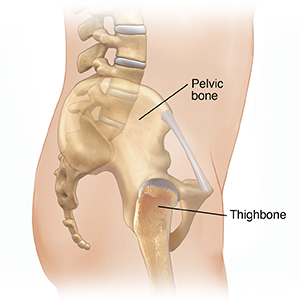
The hip joint is one of the body’s largest weight-bearing joints. It’s a ball-and-socket joint. This helps the hip remain stable even during twisting and extreme ranges of motion. A healthy hip joint allows you to walk, squat, and turn without pain.
A healthy hip
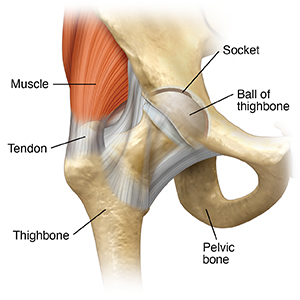
The hip joint is formed where the rounded head of the thighbone (femur) joins the pelvic bone. The joint is covered with tissue and powered by large muscles. When all the parts listed below are healthy, a hip should move easily.
-
Cartilage is a layer of smooth tissue. It covers the ball of the thighbone and lines the socket of the pelvic bone. Healthy cartilage absorbs stress and allows the ball to glide easily in the socket.
-
Muscles power the hip and leg for movement.
-
Tendons attach the muscles to the bones.
Online Medical Reviewer: Joseph, Thomas N., MD
Online Medical Reviewer: Walton-Ziegler, Olivia, MS, PA-C
Date Last Reviewed: 04/01/2024
© 2000-2026 The StayWell Company, LLC. All rights reserved. This information is not intended as a substitute for professional medical care. Always follow your healthcare professional's instructions.
Bone and Joint Care
Find expert care for joint pain, injuries, and conditions that affect how you move at the HPH Bone & Joint Centers.
Learn MoreRelated Articles
What Are Mallet, Hammer, and Claw Toes?
Mallet, hammer, and claw toes are among the most common foot problems. They are often caused by wearing shoes that are too short or heels that are too high.
The Shoulder Joint
The shoulder is made up of bones, muscles, ligaments, and tendons. Learning about the parts of the shoulder joint will help you to understand your shoulder problem.
Your Neck Muscles
Illustration and explanation of neck muscles.
Parts of a Hand
Hands are made up of more bones and moving parts than most other areas of the body. Learn more, along with helpful diagrams.