-
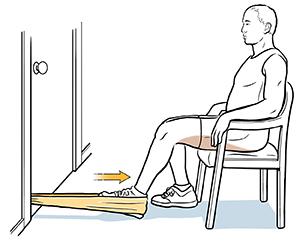
Tie the ends of an elastic exercise band or tubing into a large, strong knot. Close the door on the elastic band, so the knot is on one side and the loop of the band is on the other. The elastic band should be close to the floor. You should be on the side of the door with the loop.
-
Sit in a chair facing the closed door. Slip the loop of the elastic exercise band around the heel of your leg.
-
Slowly pull the elastic band backward along the floor with your heel. Stop when you can’t pull it any farther. Hold in place for
10 seconds, or as advised. Slowly return your leg to the starting position. -
Switch sides and repeat, if advised.
-
Repeat
5 to 10 times, or as advised.
Safety tip: Take it slowly. If you do too much too soon, you can create new knee problems, or reinjure your knee.
Author: Wheeler, Brooke
© 2000-2026 The StayWell Company, LLC. All rights reserved. This information is not intended as a substitute for professional medical care. Always follow your healthcare professional's instructions.
Bone and Joint Care
Find expert care for joint pain, injuries, and conditions that affect how you move at the HPH Bone & Joint Centers.
Learn MoreRelated Articles
Self-Care for Strains and Sprains
Most minor strains and sprains can be treated with self-care. But if you have torn tissue or damaged blood vessels, nerves, or bones, be sure to call your healthcare provider.
Back Safety: Sitting
Sitting can strain your back if you don't do it right. Learn the right moves to protect your back.
The Side-Bend Stretch: A Gentle Exercise
Follow these step-by-step instructions for the side-bend stretch. This exercise stretches and strengthens the intercostal muscles, which help support the ribs.
Back Safety: Poor Posture Hurts
An unhealthy spine often starts with bad habits. Poor movement patterns and posture problems are common causes of back pain. Disk, bone, nerve, and soft tissue problems can all be affected by poor posture.