After your amputation, you’ll be taught how to transfer safely. This means learning to move between two surfaces, such as bed and wheelchair. Safe transferring is crucial to prevent falls and protect your wound as it heals. The type of transfer you use will depend on your overall health and strength. Two types of transfers you may learn are slide board transfers and pivot transfers.
What is a slide board transfer?
A slide board is a flat, rigid board made of wood or plastic. It bridges 2 surfaces, such as a bed and wheelchair. The board lets you scoot on your buttocks between surfaces without having to use your legs. A slide board transfer can be done on your own or with help, if needed.
How to use a slide board
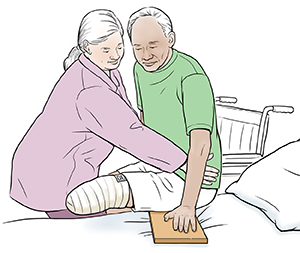
At first, you’ll need help with the slide board transfer. In time, you may be able to use the slide board by yourself.
-
If transferring from a wheelchair, place the wheelchair as close as you can to the second surface, such as a bed or toilet. Be sure to lock the wheels of the chair.
-
You or your helper slide one end of the board beneath your buttocks. The other end is placed flat on the surface you're moving onto.
-
Use your upper body to scoot yourself along the board toward the second surface. If needed, a helper can assist you. At first, you may need to wear a gait belt. This special support belt lets a helper support you more easily.
-
Once you're on the second surface, the slide board can be removed. Keep the board within easy reach.
Pivot transfers
Pivot transfers can be used if you have enough strength in your intact limb and upper body. For safety, practice pivot transfers with a helper. Don’t try to pivot transfer alone until you’re told it's safe.
-
If transferring from a wheelchair, place the wheelchair as close as you can to the second surface, such as a bed or toilet. Be sure to lock the wheels of the chair.
-
Place your foot flat on the floor. Use your arms to push up into a standing position. Hold on to your helper for balance and support. Or you can support your weight on a walking aid, such as a walker or crutches.
-
Shift your weight and reach toward the second surface. Rest your arms on the second surface for safety. If you’re wearing a gait belt, a helper can use it to help you shift your weight.
-
Turn or pivot on your foot so your buttocks are toward the second surface.
-
Sit down onto the second surface.
Online Medical Reviewer: Daphne Pierce-Smith RN MSN
Online Medical Reviewer: Thomas N Joseph MD
Online Medical Reviewer: Trina Bellendir PT
Date Last Reviewed: 03/01/2024
© 2000-2026 The StayWell Company, LLC. All rights reserved. This information is not intended as a substitute for professional medical care. Always follow your healthcare professional's instructions.
Bone and Joint Care
Find expert care for joint pain, injuries, and conditions that affect how you move at the HPH Bone & Joint Centers.
Learn MoreRelated Articles
Sitting with Crutches (Weight Bearing)
These images show how to sit safely with crutches.
Discharge Instructions: Using a Jewett Brace
A Jewett brace keeps your back in position while it is healing after surgery or injury. Wear your brace as directed by your doctor.
Knee Rehabilitation: Heel Raise
Heel raises can help rehabilitate your knee.
Phantom Sensation and Phantom Pain After Amputation
Learn how to manage phantom sensation and phantom pain after amputation.