Although a bunion won't go away, wearing shoes that fit correctly will often relieve the pain. Padding the bunion and icing it may also help. Bunions that remain painful may need surgery.
Shoes
To relieve a bunion, you don't have to buy shoes that are out of fashion. But follow these tips:
- Shop for shoes late in the day. This is when your feet are the largest.
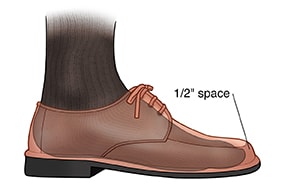
- Have both feet measured. Fit shoes to your larger foot.
- Look for shoes that have the same shape as your foot but are slightly wider across the toes.
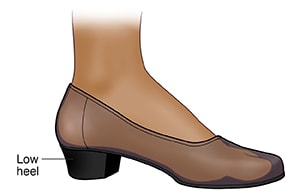
- Choose low-heeled shoes.
- Always try shoes on. Stand up and walk around. If the shoes aren't comfortable, don't buy them.
Ice massage
To help relieve a painful bunion, put an ice cube in a plastic bag. Rub the ice on the bunion for
Pads
You may want to put a bunion-shield type of pad over the bunion to cushion it. You can buy bunion pads at most drugstores. Also, you can use toe spacers or other inserts in your shoe to help decrease the pain from a bunion.
Surgery
If wearing wider shoes and padding the bunion does not relieve the pain, your doctor may suggest surgery. During surgery, the bunion is shaved away and the bones are put back in a straight line.
Online Medical Reviewer: Louise Cunningham RN BSN
Online Medical Reviewer: Raymond Turley Jr PA-C
Online Medical Reviewer: Thomas N Joseph MD
Date Last Reviewed: 09/01/2025
© 2000-2026 The StayWell Company, LLC. All rights reserved. This information is not intended as a substitute for professional medical care. Always follow your healthcare professional's instructions.
Bone and Joint Care
Find expert care for joint pain, injuries, and conditions that affect how you move at the HPH Bone & Joint Centers.
Learn MoreRelated Articles
Treating Ankle Sprains
Learn how to treat ankle sprains.
Kneecap (Patella) Surgery: Realignment
Some procedures may be done using arthroscopy, a method that uses tiny incisions and special instruments to look and work inside the knee joint. Other procedures need open surgery. The kneecap can be realigned to improve its tracking. To do this, soft tissue may be cut, tightened, or moved.
Upper Arm Fracture Open Reduction and Internal Fixation (ORIF)
Open reduction and internal fixation (ORIF) is a type of surgery used to stabilize and heal a broken bone. You may need this procedure to treat your broken arm. Read on to learn what to expect before, during, and after this surgery.
Hip Arthroscopy: Repairing Femoroacetabular Impingement
When excess bone forms on the edge of the ball or the socket of the hip, it's called FAI (femoroacetabular impingement). This can cause pain and limit movement. Arthroscopy can fix FAI. It uses small incisions and special tools. Read on to learn more.