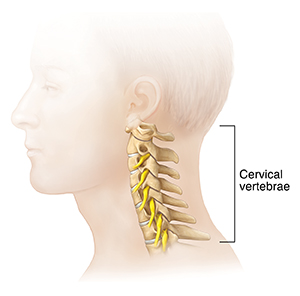
The cervical bones (vertebrae) are the top seven bones of your spine. They are located along your neck, just below the skull. Fusing vertebrae in the neck may help ease neck and arm pain. It may also help relieve progressive paralysis caused by compression of your nerve roots or spinal cord. Two or more vertebrae in your neck are fused. Fusion may be done through a cut in the front or the back of the neck. The surgery can take from 1 to 4 hours.
The fusion procedure
These steps apply to fusion from the front of the neck:
-
A head clamp or strap may be put on to align your neck.
-
The skin is cut and the muscles, blood vessels, trachea, and esophagus are pushed to one side to get to the vertebrae and disks.
-
An X-ray is done to check that the right spinal level is being operated on.
-
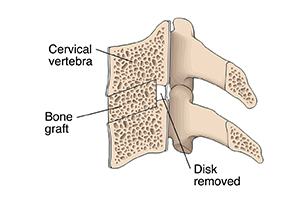
The disk is removed from between the vertebrae to be fused.
-
Bone spurs are removed.
-
A bone graft or intervertebral implant filled with bone is placed into the now-empty space between the vertebrae. Screws, plates, or a plate with screws are often placed in to ensure additional stability. In time, the graft and the bone around it will grow into a solid unit.
-
To help keep your spine steady and promote fusion, extra support with a cervical collar may be used.
-
A drain can be left in the wound for 1 or 2 days.
-
The incision is closed with stitches, glue, or staples.
-
A neck brace, rigid or soft, might be placed on your neck.

Bone and Joint Care
Find expert care for joint pain, injuries, and conditions that affect how you move at the HPH Bone & Joint Centers.
Learn MoreRelated Articles
Surgery for Shoulder Impingement: Your Experience
Surgery can help free up space in your shoulder joint. This relieves symptoms of impingement. Prepare for surgery as instructed. If you don’t, your surgery may have to be rescheduled. Your healthcare provider will give you instructions for recovering at home. If you have any questions, be sure to get them answered.
Hip Arthroscopy: After Surgery
Know what to expect after arthroscopy on your hip.
Knee Arthroscopy: Conditions Treated
Arthroscopy is used to find and treat knee problems. These include tears in the meniscal cartilage, joint loose bodies, or anterior cruciate ligament (ACL) tears.
Treating Corns and Calluses
Learn about the different treatments for corns or calluses.