Casting the fracture
To make sure the bone is lined up the right way, an X-ray is taken. Then the ankle is put in a cast to hold the bone in place during healing. You’ll likely have to wear the cast for several weeks. For less severe fractures, a walking boot, brace, or splint may be all that’s needed to hold the bone in place during healing.
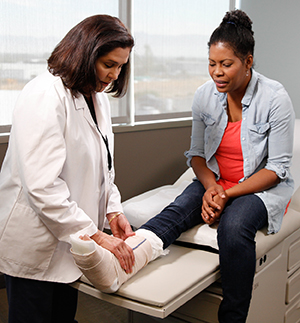
Closed reduction
If you have a clean break that is not lined up well with little soft tissue damage, closed reduction may be used. This means that no cuts (incisions) are made in the skin. Before the procedure, you may be given medicine to relax your muscles. Then your healthcare provider manually readjusts the position of the broken bone.
Open reduction
Open reduction and internal fixation is a surgical procedure which may be needed for displaced fractures, fractures that involve the joint, or open fractures. (An open fracture is one in which the bone has poked through the skin.) Your surgeon makes one or more cuts (incisions) to realign the bone and fix soft tissue. You will be given medicine during the procedure to let you sleep and relax your muscles. Screws or plates may be used to hold the bone in place during healing.
The road to healing
Once your fracture has been treated, your healthcare provider will tell you how to help it heal. You may be told to limit ankle use or weight-bearing activities. You may have to take medicines and elevate the foot. If you have a cast, remember to keep it dry.
Online Medical Reviewer: Rahul Banerjee MD
Online Medical Reviewer: Ronald Karlin MD
Online Medical Reviewer: Stacey Wojcik MBA BSN RN
Date Last Reviewed: 09/01/2025
© 2000-2026 The StayWell Company, LLC. All rights reserved. This information is not intended as a substitute for professional medical care. Always follow your healthcare professional's instructions.
Bone and Joint Care
Find expert care for joint pain, injuries, and conditions that affect how you move at the HPH Bone & Joint Centers.
Learn MoreRelated Articles
Treating Ankle Sprains
Learn how to treat ankle sprains.
Kneecap (Patella) Surgery: Realignment
Some procedures may be done using arthroscopy, a method that uses tiny incisions and special instruments to look and work inside the knee joint. Other procedures need open surgery. The kneecap can be realigned to improve its tracking. To do this, soft tissue may be cut, tightened, or moved.
Upper Arm Fracture Open Reduction and Internal Fixation (ORIF)
Open reduction and internal fixation (ORIF) is a type of surgery used to stabilize and heal a broken bone. You may need this procedure to treat your broken arm. Read on to learn what to expect before, during, and after this surgery.
Hip Arthroscopy: Repairing Femoroacetabular Impingement
When excess bone forms on the edge of the ball or the socket of the hip, it's called FAI (femoroacetabular impingement). This can cause pain and limit movement. Arthroscopy can fix FAI. It uses small incisions and special tools. Read on to learn more.



