Charcot foot is also called diabetic foot. The only way to stop the progression of it is to stay off the foot long enough for it to heal. Your doctor will prescribe treatment to help healing.
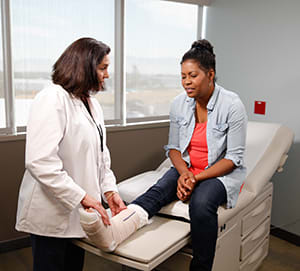
Staying non-weight-bearing
While fractures are healing, it is crucial that you keep your weight off your foot. This is called non-weight-bearing. Your doctor may ask you not to walk at all. Or they may prescribe a special device, such as crutches. Remember: You often don't feel pain with Charcot foot. So even if you feel fine, stay off your foot until your doctor says it's okay.
Using special devices
Special devices may help you keep weight off your foot. That way, your bones can heal smoothly. A wheelchair, crutches, or brace may be prescribed alone or with a cast. A Charcot restraint orthotic walker (CROW) may be prescribed. This is a custom rigid boot. It lets you keep putting weight on your foot. But it also protects your foot. Other devices may be prescribed to help you keep your foot raised while at home. An elastic bandage wrap or special stocking may also be advised. This compresses your foot to reduce swelling and aid healing.
Using custom footwear
Once your foot has healed, you may be fitted for custom shoes or inserts (orthoses). Custom footwear is specially made to fit the shape of your foot. This can help prevent ulcers caused by the rubbing from store-bought shoes. If custom footwear doesn't stop ulcers from forming, surgery may be needed to correct the deformity causing the ulcers.
It's important to look at your feet carefully every day. This includes looking between your toes and at the bottom of your feet. Call your doctor right away if any area on your foot shows irritation or stays red for more than 30 minutes after you take off a special device, such as a CROW or a brace.

Bone and Joint Care
Find expert care for joint pain, injuries, and conditions that affect how you move at the HPH Bone & Joint Centers.
Learn MoreRelated Articles
Knee Replacement Surgery
When your knee is badly damaged by disease or injury, a knee replacement may be considered. During knee replacement surgery, your joint surfaces are replaced by prostheses. These are plastic and metal parts that are used to replace your joint surfaces. Read on to learn more.
Foot Surgery: Bunions
A bunion is a bony bump. When the distance between the first and second metatarsal bones of the foot is greater than normal, the big toe may turn toward the other toes. A mild bunion may then form causing foot pain and swelling. Bunions are most often found near the joint at the base of the big toe. Bunions tend to run in families. They may cause pain, swelling, and skin irritation.
Having Minimally Invasive Total Knee Replacement
Total knee replacement is a type of surgery to replace a damaged knee joint. It is done by an orthopedic surgeon.
Achilles Tendon Repair Surgery
Achilles tendon repair surgery is a type of surgery to fix a damaged Achilles tendon. Learn more about the surgery, including why you might need it, what the risks are, how to get ready for it, and what happens during and after the surgery.