The goal of your treatment for de Quervain's tenosynovitis (say "duh-kair-VANZ ten-oh-sin-uh-VY-tus") is to ease your pain and allow you to use your thumb again. Treatment will depend on how bad the pain is.
Nonsurgical treatment
Just taking a break from the activities that caused your pain may be enough. Your doctor may also have you take nonsteroidal, anti-inflammatory drugs, such as ibuprofen. You may also wear a splint for a few weeks to rest the thumb and wrist. To ease swelling, your doctor may inject an anti-inflammatory medicine, such as cortisone around the tendons.
You may have more pain at first. But in a few days your thumb should feel better. Physical therapy or therapy with an occupational therapist or certified hand therapist is often helpful as well.
Surgery
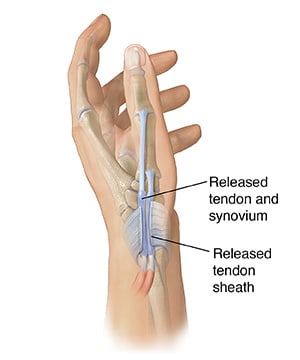
If other kinds of treatment don't ease your pain, or if the pain is bad, you may need surgery. The sheath that surrounds the tendons is released so the tendons can move more easily. This helps reduce the inflammation. It also allows you to straighten your thumb without pain.
Surgery is done with local or regional anesthetic on an outpatient basis, so you can go home the same day. You will likely have a splint or dressing on your wrist for a few days while the tissue heals. You may need physical therapy to help make the muscles strong. Your doctor will talk with you about the risks and possible problems of having surgery.

Bone and Joint Care
Find expert care for joint pain, injuries, and conditions that affect how you move at the HPH Bone & Joint Centers.
Learn MoreRelated Articles
Knee Replacement Surgery
When your knee is badly damaged by disease or injury, a knee replacement may be considered. During knee replacement surgery, your joint surfaces are replaced by prostheses. These are plastic and metal parts that are used to replace your joint surfaces. Read on to learn more.
Foot Surgery: Bunions
A bunion is a bony bump. When the distance between the first and second metatarsal bones of the foot is greater than normal, the big toe may turn toward the other toes. A mild bunion may then form causing foot pain and swelling. Bunions are most often found near the joint at the base of the big toe. Bunions tend to run in families. They may cause pain, swelling, and skin irritation.
Having Minimally Invasive Total Knee Replacement
Total knee replacement is a type of surgery to replace a damaged knee joint. It is done by an orthopedic surgeon.
Getting Ready for Knee Replacement: Preparing for Your Recovery
You can do a lot now to make your recovery from knee replacement quicker and easier.