When you first learn you have plantar fasciitis, your doctor will look for the cause of your problem. Then they can suggest ways to ease pain. If your pain is due to poor foot mechanics, sometimes custom-made shoe inserts (orthoses) may help.
Ease symptoms
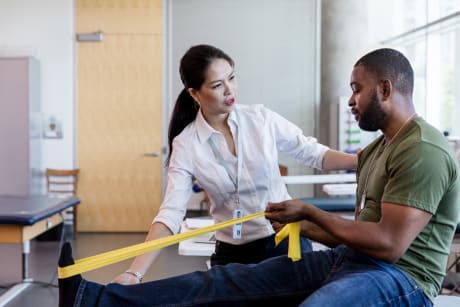
- To help ease symptoms, stretch. The treatment that works well for plantar fasciitis is stretching your calves and plantar fascia. The fascia is a fibrous structure that runs under the skin from your heel to your toes. Your doctor can give you a stretching program to do 2 to 3 times a day. If your symptoms are worse when first getting out of bed in the morning, stretch before getting out of bed. This can help because you are stretching before putting weight on your feet.
- To relieve mild symptoms, try ibuprofen, acetaminophen, or other medicines as directed by your doctor. Freezing a water bottle and gently messaging the area with the frozen water bottle may also help. Gel heel cup inserts in your shoes can help. Wear footwear that fits well and supports your foot.
- To reduce severe pain and swelling, your doctor may give you pills or injections. In some cases, you may need a walking cast or boot. Physical therapy, ultrasound therapy, or a daily stretching program may also be recommended. Surgery is rarely needed.
- To ease symptoms caused by poor foot mechanics, your foot may be taped or over-the-counter or custom-made orthotics may be used. This supports the arch and temporarily controls movement. Night splints may also help by stretching the fascia.
Control movement
If taping helps, your doctor may prescribe orthoses. These are inserts built from plaster casts of your feet. They control the way your foot moves. This may improve your symptoms.
Reduce overuse
Every time your foot strikes the ground, the plantar fascia is stretched. You can reduce the strain on the plantar fascia and the chance of overuse by:
- Losing any extra weight you may have.
- Not running on hard or uneven ground.
- Using orthoses, supportive footwear, or heel pads, if recommended, in your shoes and slippers or wear other cushioned footwear at home.
If surgery is needed
Your doctor may consider surgery if other types of treatment don't control your pain. During surgery, the plantar fascia is partially cut to release tension. As you heal, fibrous tissue fills the space between the heel bone and the plantar fascia.

Bone and Joint Care
Find expert care for joint pain, injuries, and conditions that affect how you move at the HPH Bone & Joint Centers.
Learn MoreRelated Articles
Knee Osteotomy
Knee osteotomy is surgery to shift the positioning of the knee. Read this to learn about the surgery and the recovery.
Microdiskectomy
During a microdiscectomy, some disk is removed. In most cases, bone must first be removed to expose the damaged disk. The part of the disk outer wall and soft center that presses on the nerve can then be removed. There is usually enough disk remaining to cushion the vertebrae.
Treating Osgood-Schlatter Disease
Osgood-Schlatter disease is a condition that affects the knee. It most often affects young, growing teens. Learn details about treatment here.
Kneecap Surgery: Removing Damaged Cartilage
Surgery may be used when pain severely limits your activities. Or it may be done when a rehab program or other nonsurgical treatments just are not helping enough. Some procedures may be done using arthroscopy. This method uses tiny incisions and special instruments to look and work inside the knee joint. Other procedures need open surgery.



