Having scoliosis means that your spine (backbone) curves and twists from side to side instead of growing straight. Your healthcare provider will suggest the best treatment for you based on your age, how much more you are likely to grow, and the size and type of your spinal curve.
How is scoliosis treated?
The three types of treatment for scoliosis are:
-
Observation. Watching a small curve to see if it gets better or worse as you grow.
-
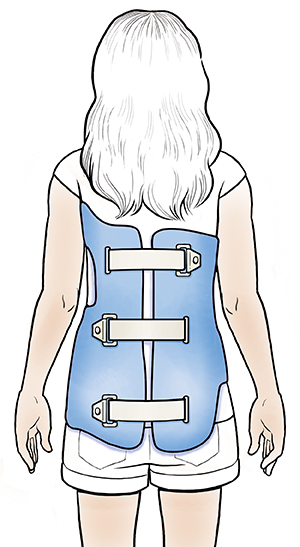
Bracing. Wearing a brace until your spine is fully grown to keep your curve from getting worse. For many teens with scoliosis, wearing a brace is the best treatment. It may also help keep you from needing surgery.
-
Surgery. Operating to correct a very serious curve.
How a brace works
-
A scoliosis brace is made out of plastic and is shaped to fit your body. The brace holds your spine in place to keep your curve from getting worse. To do this, you need to wear it almost all the time until you are fully grown.
-
There are several kinds of braces. Your healthcare provider will talk to you about the best one for your type of scoliosis.
-
An orthotist is the person who makes and fits your brace. You will see the orthotist a few times for adjustments to be sure the brace fits correctly.
Why wear your brace?
The brace helps keep your scoliosis from getting worse. If your scoliosis does get worse, you may need surgery. Surgery often leaves a big scar. And surgery can be hard to recover from. Also, it may be months after surgery before you can go out and be active again.
To learn more
-
National Scoliosis Foundation 800-673-6922
-
Scoliosis Research Society 414-289-9107

Bone and Joint Care
Find expert care for joint pain, injuries, and conditions that affect how you move at the HPH Bone & Joint Centers.
Learn MoreRelated Articles
Achilles Tendon Repair Surgery
Achilles tendon repair surgery is a type of surgery to fix a damaged Achilles tendon. Learn more about the surgery, including why you might need it, what the risks are, how to get ready for it, and what happens during and after the surgery.
Femur Fracture Open Reduction and Internal Fixation
Open reduction and internal fixation (ORIF) is a type of surgery used to stabilize and heal a broken bone. You might need this procedure to treat your broken femur. Read on to learn what to expect before, during, and after this surgery.
Spinal Fusion: Posterior Lumbar
Fusing vertebrae in the lumbar curve spine may help ease lower back and leg pain. Posterior lumbar fusion is done through an incision in your back. The graft is put between the vertebrae in one of two places: in the disk space or between the transverse processes.
Colles Wrist Fracture, Reduction Needed
You have a break (fracture) of the forearm bone (radius) where it attaches to your wrist. This type of fracture may be called a Colles fracture. The bone is out of place. It must be set (reduced) to make it straight again. Learn about how to care for yourself at home.