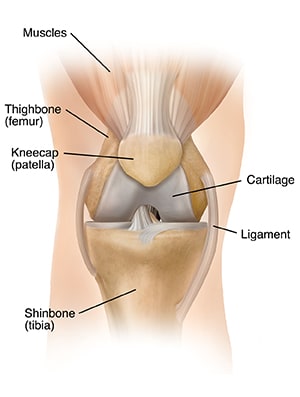
The knee is a joint that works like a hinge. It is formed where the thighbone (femur), shinbone (tibia), and kneecap (patella) meet. It is supported by muscles, tendons, and ligaments. It is also lined with cushioning cartilage. Over time, cartilage can wear away. As it does, the knee becomes stiff and painful. An artificial knee joint (prosthesis) can replace the painful joint and restore movement.
A healthy knee
A healthy knee joint bends easily. Cartilage is a smooth tissue. It covers the ends of the thighbone and shinbone and the underside of the kneecap. Healthy cartilage absorbs stress and allows the bones to glide freely over each other. Joint fluid lubricates the cartilage surfaces, making movement even easier.
A problem knee
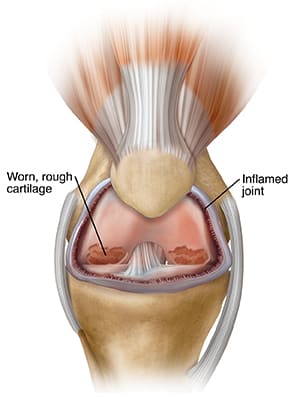
A problem knee is often stiff and painful. Cartilage cracks or wears away due to usage, inflammation, or injury. Worn, roughened cartilage no longer lets the joint glide freely. So it feels stiff and painful. As more cartilage wears away, exposed bones rub together when the knee bends, causing pain. With time, bone surfaces also become rough, making pain worse.
A knee prosthesis
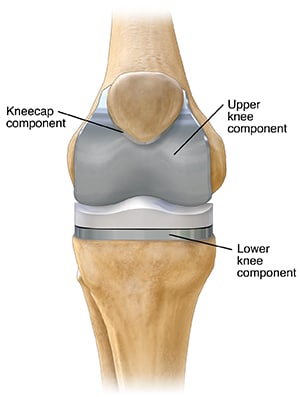
A knee prosthesis lets your knee bend easily again. The roughened ends of the thighbone and shinbone and the underside of the kneecap are replaced with metal and strong plastic parts. With new smooth surfaces, the bones can once again glide freely without pain. A knee prosthesis does have limits. But it can let you walk and move with greater comfort.
Online Medical Reviewer: L Renee Watson MSN RN
Online Medical Reviewer: Raymond Turley Jr PA-C
Online Medical Reviewer: Thomas N Joseph MD
Date Last Reviewed: 09/01/2025
© 2000-2026 The StayWell Company, LLC. All rights reserved. This information is not intended as a substitute for professional medical care. Always follow your healthcare professional's instructions.
Bone and Joint Care
Find expert care for joint pain, injuries, and conditions that affect how you move at the HPH Bone & Joint Centers.
Learn MoreRelated Articles
Laminotomy
Laminotomy is a surgery that takes out a small amount of bone from the spine. This takes pressure off nerves in the low back, which eases symptoms.
Treating Ankle Sprains
Learn how to treat ankle sprains.
Kneecap (Patella) Surgery: Realignment
Some procedures may be done using arthroscopy, a method that uses tiny incisions and special instruments to look and work inside the knee joint. Other procedures need open surgery. The kneecap can be realigned to improve its tracking. To do this, soft tissue may be cut, tightened, or moved.
Upper Arm Fracture Open Reduction and Internal Fixation (ORIF)
Open reduction and internal fixation (ORIF) is a type of surgery used to stabilize and heal a broken bone. You may need this procedure to treat your broken arm. Read on to learn what to expect before, during, and after this surgery.