Skier’s thumb (sometimes called gamekeeper’s thumb) is an injury to the ulnar collateral ligament. This ligament is located at the base of your thumb on the side near the index (pointer) finger. It helps keep your thumb stable when grasping or pinching objects. With skier’s thumb, the ligament is stretched or torn (sprained). This can cause pain and can limit movement and use of the thumb. You may need surgery to repair or reconstruct the ligament and restore function.
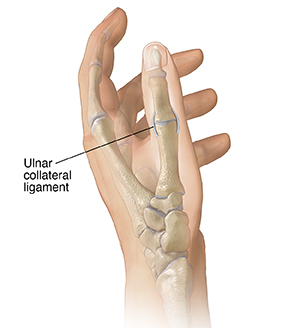
Why surgical repair of skier’s thumb is done
If your ligament is severely stretched or torn, or if nearby tissues and bone are also injured, your injury may not heal correctly on its own. You may need surgery. This can help the ligament heal and restore movement to and full use of your thumb.
How surgical repair of skier’s thumb is done
The surgery is most often done on an outpatient basis. That means that you go home the same day. During the surgery:
-
You are given medicine to help you relax and to prevent pain. You may be drowsy or completely asleep during the procedure. You may also have a nerve block. This numbs your arm during the surgery and for a time afterward.
-
The surgeon makes a cut (incision) at the base of your thumb.
-
The surgeon reattaches the ligament to the bone using stitches (sutures) and often small anchors. They will also repair any injury to the tissues around it. If a bone fracture is present, the surgeon may repair it with wires or screws.
-
When the procedure is done, the surgeon closes the skin incision with sutures.
-
Your doctor will put a splint on your hand to hold your thumb still while the repair heals.
Risks of surgical repair for skier’s thumb
-
Bleeding
-
Infection
-
Damage to nearby nerves leading to numbness and tingling
-
Stiffness or reduced range of motion of the thumb
-
Arthritis
Author: Michels, Karen
Online Medical Reviewer: Kenny Turley PA-C
Online Medical Reviewer: L Renee Watson MSN RN
Online Medical Reviewer: Thomas N Joseph MD
Date Last Reviewed: 05/01/2025
© 2000-2026 The StayWell Company, LLC. All rights reserved. This information is not intended as a substitute for professional medical care. Always follow your healthcare professional's instructions.
Bone and Joint Care
Find expert care for joint pain, injuries, and conditions that affect how you move at the HPH Bone & Joint Centers.
Learn MoreRelated Articles
Foot Surgery: Bunions
A bunion is a bony bump. When the distance between the first and second metatarsal bones of the foot is greater than normal, the big toe may turn toward the other toes. A mild bunion may then form causing foot pain and swelling. Bunions are most often found near the joint at the base of the big toe. Bunions tend to run in families. They may cause pain, swelling, and skin irritation.
Total Shoulder Replacement Surgery
During shoulder replacement surgery, all or part of your problem shoulder is replaced with an artificial joint, called a prosthesis.
Spinal Fusion: Posterior Lumbar
Fusing vertebrae in the lumbar curve spine may help ease lower back and leg pain. Posterior lumbar fusion is done through an incision in your back. The graft is put between the vertebrae in one of two places: in the disk space or between the transverse processes.
Spinal Fusion
During spinal fusion, your surgeon locks together, or fuses, certain bones in your spine that are causing pain. This limits the movement of these bones, which may help ease your pain. Even so, you may feel more flexible after a fusion because you can move with less pain.