Stress fractures are very small, fine breaks in a bone. They most often occur in the bones of the lower legs and feet. Stress fractures are caused by repeated shock to the bone. They are most common with high-impact sports, such as basketball, tennis, and running. Several things can help lead to a stress fracture. They include poorly cushioned shoes, hard surfaces, tight muscles or tendons, and a sudden increase in exercise time or intensity.
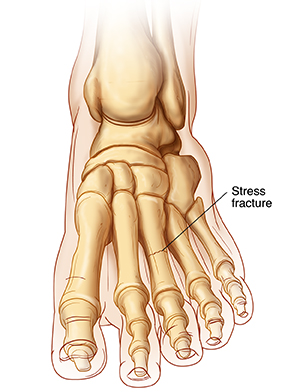
Symptoms of stress fractures
A stress fracture may cause sharp pain that slowly increases during activity and goes away with rest. The pain often gets worse when weight is put on the leg or foot. In some cases, a stress fracture may cause no pain at all.
Your evaluation
Your healthcare provider will ask you questions about your activities and your health history. Tell your provider about any changes to your exercise or training routine, such as a change in playing surface. Stress fractures don’t always show up on X-rays. So your doctor may order bone scans, or magnetic resonance imaging (MRI).
Treating stress fractures
Rest is the best way to treat a stress fracture. If the leg or foot is not rested, the fracture will likely become worse and harder to heal. To ensure proper healing:
-
Replace high-impact activities with low impact ones, such as swimming or cycling, until the fracture has healed. This takes about 6 to 8 weeks.
-
Use ice and over-the-counter pain relievers as directed by your healthcare provider.
-
Use crutches as directed by your doctor if walking is painful.
-
Wear a special walking cast or shoe if your healthcare provider recommends them. These can improve healing of certain types of fractures.
-
Stretch and warm-up before activities.
-
Ease back into activity when your provider gives you the OK.
Preventing stress fractures
To help prevent stress fractures:
-
Ease into new sports activity. If you run, don’t start at 5 miles a day. Instead, start with 1 mile and slowly increase your miles.
-
Switch between different activities. Work low-impact activities into your routine.
-
People with a uterus should be sure to get enough calcium and vitamin D. Ask your healthcare provider about supplements.
-
Wear the right shoes for the activity you’re doing. Don’t wear shoes that are worn out.
-
Stop an activity if you have pain or swelling. Rest until the pain goes away.
Online Medical Reviewer: Image reviewed by StayWell art team.
Online Medical Reviewer: Joseph, Thomas N., MD
Online Medical Reviewer: Larson, Kim, APRN, FNP
Online Medical Reviewer: Turley, Raymond Kent, BSN, MSN, RN
Date Last Reviewed: 04/01/2024
© 2000-2026 The StayWell Company, LLC. All rights reserved. This information is not intended as a substitute for professional medical care. Always follow your healthcare professional's instructions.
Bone and Joint Care
Find expert care for joint pain, injuries, and conditions that affect how you move at the HPH Bone & Joint Centers.
Learn MoreRelated Articles
ACL and PCL (Knee Ligament Injury)
An ACL or PCL injury occurs when the ligament has been torn. The tear may be partial or complete. Here's how to care for yourself at home.
Understanding a Clavicle Fracture
A fracture of the clavicle is a broken collarbone. Clavicle fractures occur most often along the middle of the bone. Depending on how badly the bone is broken, healing may take a few months or longer.
Stable Pelvic Fracture
You have a break or fracture of the pelvic bone. Read this to know what to expect.
Rheumatoid Arthritis
Rheumatoid arthritis is a chronic disease that mainly affects the joints. Read on to learn how to care for yourself at home.