Your knee is a complex joint with many parts. These parts work together to give you the flexibility and motion needed for walking, running, and jumping. But with Osgood-Schlatter disease, knee pain can leave you on the sidelines. Osgood-Schlatter disease is an overuse injury that affects children and adolescents who play sports. It occurs more frequently in athletes who participate in sports that involve running and jumping, including:
-
Basketball
-
Volleyball
-
Sprinting
-
Gymnastics
-
Football
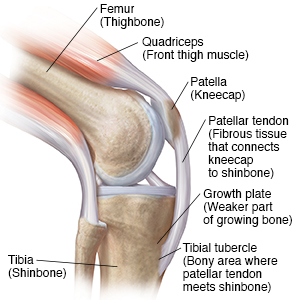
A knee with Osgood-Schlatter disease
When your leg moves, the thigh muscle pulls the kneecap. Next, the kneecap pulls a tough band of connective tissue. This tissue then pulls on a bony area at the top of your shinbone.
In some kids, all that pulling can cause Osgood-Schlatter disease. This causes pain and often swelling on the front of the knee.
The symptoms may limit your activities. This is because the pulling happens in an area of the bone that’s still growing. As a rule, growing parts of a bone are weaker than other parts. This makes the growing area more likely to get injured.
Online Medical Reviewer: Marianne Fraser MSN RN
Online Medical Reviewer: Raymond Turley Jr PA-C
Online Medical Reviewer: Vinita Wadhawan Researcher
Date Last Reviewed: 01/01/2025
© 2000-2026 The StayWell Company, LLC. All rights reserved. This information is not intended as a substitute for professional medical care. Always follow your healthcare professional's instructions.
Bone and Joint Care
Find expert care for joint pain, injuries, and conditions that affect how you move at the HPH Bone & Joint Centers.
Learn MoreRelated Articles
Understanding a Clavicle Fracture
A fracture of the clavicle is a broken collarbone. Clavicle fractures occur most often along the middle of the bone. Depending on how badly the bone is broken, healing may take a few months or longer.
Stable Pelvic Fracture
You have a break or fracture of the pelvic bone. Read this to know what to expect.
Rheumatoid Arthritis
Rheumatoid arthritis is a chronic disease that mainly affects the joints. Read on to learn how to care for yourself at home.
ACL and PCL (Knee Ligament Injury)
An ACL or PCL injury occurs when the ligament has been torn. The tear may be partial or complete. Here's how to care for yourself at home.