These exercises help build upper body strength. This helps when you need to use a walker or crutches after surgery. Be sure to exercise both arms. Your physical therapist or surgeon may also tell you to use weights when doing these exercises.
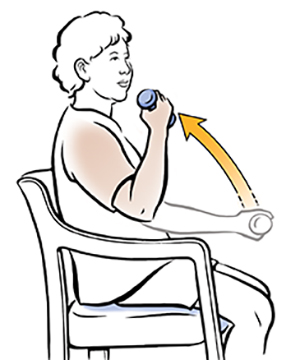
Biceps curls
-
Sit up straight in a chair. Keep your elbow close to your body and your wrist straight.
-
Bend your arm, moving your hand up to your shoulder. Then slowly lower your arm.
Triceps curls
-
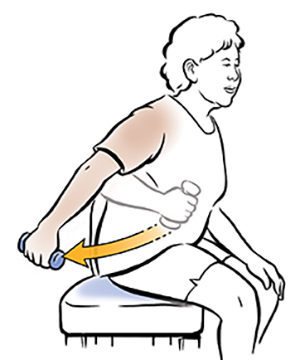
Sit, leaning forward from the waist.
-
Bend your elbow so that your forearm is parallel to the floor. Then straighten your elbow as you extend your arm behind you.
Seated press-ups
-
Sit in a sturdy chair with armrests.
-
With palms flat on the armrests, press down to lift your buttocks from the chair. Hold for a few seconds.
-
Bend your elbows to slowly ease back down.


Bone and Joint Care
Find expert care for joint pain, injuries, and conditions that affect how you move at the HPH Bone & Joint Centers.
Learn MoreRelated Articles
Understanding Lateral Ankle Ligament Reconstruction
Lateral ankle ligament reconstruction is a surgery to tighten and firm up 1 or more ligaments on the outside of the ankle. Learn more about this surgery.
Having Ankle Fracture Open Reduction and Internal Fixation (ORIF)
Open reduction and internal fixation (ORIF) is a type of treatment to fix a broken bone. Read on to know what to expect before, during, and after this surgery.
Microdiskectomy
During a microdiscectomy, some disk is removed. In most cases, bone must first be removed to expose the damaged disk. The part of the disk outer wall and soft center that presses on the nerve can then be removed. There is usually enough disk remaining to cushion the vertebrae.
Evaluation Procedures for Orthopedic Problems
To help the orthopedist determine your treatment, you'll need a physical exam, a medical history profile, and a description of symptoms.