Doing special exercises is the first way to treat frozen shoulder. You may see a physical therapist who can help you learn to do them. If these exercises don’t help, you may need more medical treatment.
Shoulder stretches
Doing stretches is often the best way to treat frozen shoulder. Stretching each day can help lessen the pain and restore shoulder flexibility. But it often takes a lot of time before you notice results. Try to be patient.
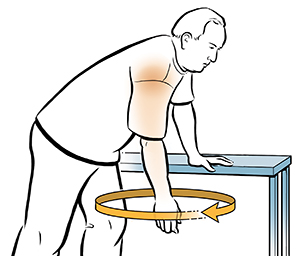
To warm up, do the “pendulum.” While standing, let the hand on your frozen side dangle freely as you hold the back of a chair or a tabletop with your other hand. Slowly make circles and side-to-side motions with the frozen arm.
Physical therapy
Your healthcare provider may refer you to physical therapy. This hands-on care helps you learn how to do stretching exercises at home. A physical therapist may also work on restoring your shoulder flexibility. To do this, they may gently stretch and move your frozen shoulder.
Tips for shoulder stretches
-
Anti-inflammatory medicines or steroid injections can help relieve pain. This may help you do your stretches. Your healthcare provider can tell you more.
-
Heat may help loosen your shoulder. Ask your provider if you should use heat.
-
A cold or ice pack can limit pain and swelling. Try icing your shoulder for a few minutes after you do your stretches. Wrap the cold or ice pack in a thin cloth to protect your skin.
Online Medical Reviewer: Raymond Turley Jr PA-C
Online Medical Reviewer: Stacey Wojcik MBA BSN RN
Online Medical Reviewer: Thomas N Joseph MD
Date Last Reviewed: 08/04/2004
© 2000-2026 The StayWell Company, LLC. All rights reserved. This information is not intended as a substitute for professional medical care. Always follow your healthcare professional's instructions.
Bone and Joint Care
Find expert care for joint pain, injuries, and conditions that affect how you move at the HPH Bone & Joint Centers.
Learn MoreRelated Articles
Trigger Point Injection
If you have muscle pain or spasms, it may be due to a trigger point, which is a tight, painful knot of muscle fiber. Your health care provider can inject medicine into the trigger point to ease pain.
Total Knee Replacement
During total knee replacement surgery, your damaged knee joint is replaced with an artificial joint (called a prosthesis). This surgery almost always reduces joint pain and improves your quality of life. Read on to learn more about the surgery.
Rotator Cuff Repair
The rotator cuff is made up of muscles and tendons that hold the shoulder in place. The rotator cuff can become injured or wear down with age. If injured, the rotator cuff may need surgery to repair it.
Arthroscopy
Arthroscopy is used to diagnose and treat joint problems. After arthroscopy, you may be able to return to the activities you enjoy.