This exercise can help build shoulder strength and relieve pain over time. Talk with your doctor before starting this exercise. Follow any special instructions from your doctor or physical therapist.
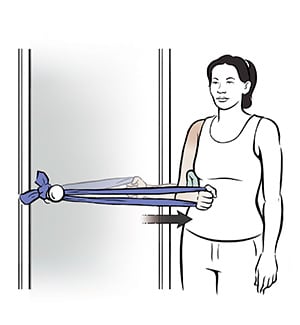
- For this exercise, you can use an elastic band. Tie the ends of the band together to make a 3-foot loop. Attach the band to a fixed object, such as a knob on a closed door.
- Standing next to the door, hold the band with your elbow bent and close to your body.
- Slowly move your hand toward your belly. Make sure your elbow stays tucked into your side.
- Hold for
1 second. Then slowly return to the starting position. - Repeat the movement
8 to 12 times per set. Do3 sets.
Frozen shoulder
Frozen shoulder is also called adhesive capsulitis. This causes restricted movement in the shoulder. If you have frozen shoulder, this exercise may cause discomfort, especially when you first get started. A multiple months may pass before you get the results you want. But once your shoulder heals, it rarely becomes frozen again. So stick to your exercise program. If you have any questions, be sure to ask your doctor.
Online Medical Reviewer: Dan Brennan MD
Online Medical Reviewer: Raymond Turley Jr PA-C
Online Medical Reviewer: Stacey Wojcik MBA BSN RN
Date Last Reviewed: 09/01/2025
© 2000-2026 The StayWell Company, LLC. All rights reserved. This information is not intended as a substitute for professional medical care. Always follow your healthcare professional's instructions.
Bone and Joint Care
Find expert care for joint pain, injuries, and conditions that affect how you move at the HPH Bone & Joint Centers.
Learn MoreRelated Articles
Shoulder Internal Rotation, Isometric (Strength)
Follow these step-by-step instructions.
Sitting with Crutches (Non-Weight Bearing)
These images will show you how to safely sit down using crutches.
Crutch Walking
A helpful, step-by-step guide to walking with crutches, including going up and down stairs.
Choosing the Right Shoes for Comfort
Your feet support the weight of your body. Repeated stress on your feet can cause damage over time. The right shoes can help protect your feet. The wrong shoes can cause problems. Learn how to find a shoe that fits your foot needs.